Kesi is a Chinese silk-tapestry technique in which weaving creates the image as well as the cloth. The supporting warp continues through the textile, while coloured weft threads work across selected parts of a design. A flower, a bird or a written character is therefore constructed in thread, rather than simply printed on a finished surface.
Understanding that structure makes kesi easier to recognise and its history easier to discuss carefully. The useful starting questions are what the textile is made of, how its image was formed, what a particular object record establishes and whose knowledge sustains the practice.
How the threads build an image
The warp is the set of threads held lengthwise on the loom; the weft crosses it. In kesi, a coloured weft does not necessarily travel from one outer edge of the fabric to the other. It can turn back where its own area of the pattern ends. Another colour occupies a neighbouring area. These local passages allow an image to develop within the woven structure.
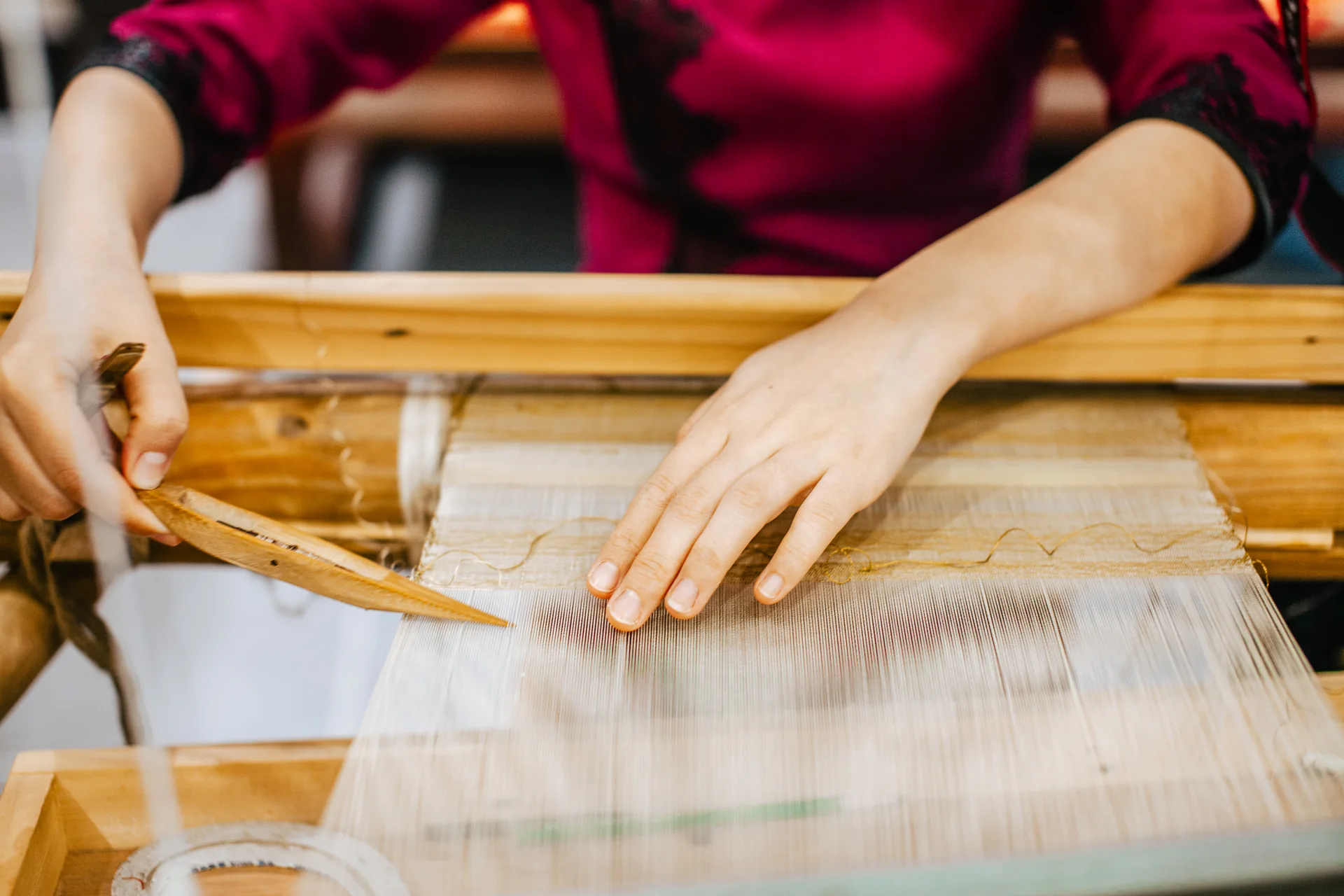
The University of Hong Kong’s University Museum and Art Gallery describes this arrangement through the term tongjing duanwei: a continuous warp combined with discontinuous weft. Its technical entry identifies raw silk for the warp and dyed silk for the weft. These are descriptions of materials and construction, not a claim that every textile carrying the name has exactly the same finish. Source: HKU museum dictionary.
Tokyo National Museum explains that the returning coloured threads can leave small gaps between areas of a pattern. This helps explain the association with slit tapestry. The name is a guide to the weaving, not an instruction to cut a completed picture out of silk. Source: Tokyo National Museum.
For someone viewing a work, the practical question is where one colour ends and another begins. A distant photograph may show the subject clearly but reveal little about those boundaries. A reliable catalogue description can therefore tell us something that a visually impressive reproduction cannot.
Kesi is weaving rather than embroidery
Silk tapestry and silk embroidery can both produce detailed pictures. Their visual resemblance does not make the processes interchangeable. The Textile Museum at George Washington University defines embroidery through needle-worked stitches that embellish fabric. In tapestry weaving, the arrangement of warp and weft forms the image within the cloth itself. Source: The Textile Museum’s terminology.
The Fitzwilliam Museum also distinguishes woven tapestry from embroidery. Its general explanation is useful for understanding the structural difference, but its discussion of European tapestry production should not be treated as evidence for Chinese workshop practices. A shared weaving principle does not mean that the histories, materials or working arrangements are identical. Source: Fitzwilliam Museum.
Technique labels still need to be read precisely. A work may combine more than one process. The Metropolitan Museum of Art describes Mythical landscape with immortals, a nineteenth-century set of ten panels, as kesi with hand-painted ink and colour. Some details were added after weaving. Calling the panels tapestry does not mean that every visible mark was woven. Source: The Met, object 13.220.83a–j.
A history grounded in identifiable objects
There is a difference between dating a surviving textile and establishing when a technique was first invented. A date attached to one object cannot settle the entire history of silk tapestry. Nor should the earlier history of wool tapestry automatically be presented as the history of kesi in silk.
Tokyo National Museum’s 2021 kesi display included a textile with clouds and an auspicious bird dated to the tenth-century Liao dynasty. Its account identifies the Song dynasty, 960–1279, as a period of sophisticated development, when richly patterned weaving could approach painting in its complexity. These are useful reference points without requiring a single, unsupported origin date.
The relationship with painting is also visible in museum collections. The Met’s Painting with Threads exhibition brought Chinese tapestries and embroideries together around landscapes, flowers, birds, immortals and calligraphy. Its interpretation connects the qualities of silk with the possibility of translating pictorial ideas into textile work. It does not suggest that weaving was merely a substitute for a more important art. Source: The Met exhibition overview.
Pictures, clothing and the setting of use
Kesi should not be understood only as a framed textile picture. Collection records show why an object’s original use matters alongside its subject.
At The Met, a seventeenth-century Chair Strip is catalogued as silk and metallic-thread tapestry. The museum explains how the floral medallion belonged over the seat, the dragon extended over the back and an upside-down crane appeared on the portion hanging behind the chair. The arrangement makes sense when the textile is considered in use, rather than as an isolated flat image. Source: The Met, object 30.75.102.
A different record, the eighteenth-century Women’s Tapestry-Woven (Kesi) Robe with Roundels, documents a garment made with silk and metallic thread. Together, these two objects show that a similar technical label can describe textiles intended for very different settings. They do not establish that all kesi was made for court dress, furniture or display. Source: The Met, object 38.74.1.
For a museum visitor or cultural organiser, this suggests a useful habit: read the function before drawing conclusions from the motif. Ask whether a piece was a garment, a covering, a hanging or part of a larger ensemble. Then separate what the record confirms from what the image merely invites you to imagine.
How to read a kesi label carefully
Start with the material and technique fields. “Silk” identifies a material; “tapestry” describes a construction. Additional words such as metallic thread or painted colour change how the object should be understood. They are not incidental details.
Next, keep the object’s date separate from the date of its acquisition, exhibition or conservation. An eighteenth-century robe donated in the twentieth century remains an eighteenth-century object in the museum’s catalogue. Likewise, a modern exhibition date is not the date when the textile was made.
Finally, look for the maker and attribution. A named person, a workshop attribution and an unidentified maker are different kinds of information. If a maker is unknown, that gap should remain visible rather than being filled with a plausible name. A museum’s credit line identifies the collection’s acquisition or donor information; it should not automatically be read as the name of the weaver.
These reading questions offer a way into the object without pretending to authenticate it. They are particularly useful when an attractive online photograph appears without the catalogue information that would explain its context.
The textile and the knowledge behind it
A preserved object and a continuing craft practice are related, but they are not the same thing. A collection can help us examine a completed textile. Understanding a living practice also requires attention to the people who make, teach and adapt it. IOV’s guide to intangible cultural heritage explains why skills and transmission matter alongside material objects.
For a contemporary maker’s account, useful questions include how the technique was learned, which terms the maker uses, how a design is developed and what kinds of work the maker chooses to undertake. The answers should come from that practitioner, not be inferred from an old textile or assigned to every workshop in a region.
This is also a sound approach to presenting folk art through people and practice. Credit a maker when the identity is established. Keep regional or family knowledge attached to its actual source. Treat innovation as something to investigate in a particular workshop, rather than assuming that every change is either a loss of tradition or proof of revival.
Kesi becomes more understandable when these questions remain together: how the threads form the image, how an object was used and how people learn the work. The finished surface is the beginning of that inquiry, not its whole story.